
Every byte of data holds potential insights waiting to be discovered. But turning raw data into actionable insights has always been a complex challenge. Modern organizations need systems that can store massive amounts of diverse data while serving both traditional analytics and machine learning workloads — from basic reporting to complex AI model training. The journey to solve this challenge has led to several evolutionary steps in data architecture, culminating in an innovative solution: the data lakehouse.
The Data Warehouse Era: Structured Beginnings
When data warehouses emerged in the late 1980s, they represented a significant breakthrough in data management. Organizations could finally separate their analytical workloads from their operational databases, preventing complex SQL queries from impacting their main services.
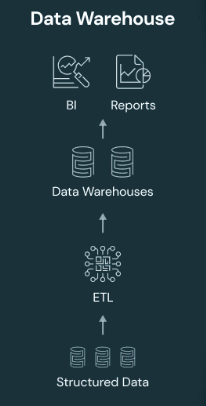
Data warehouses excel at handling structured data with well-defined schemas, enabling businesses to build robust reporting and business intelligence solutions. Unlike transactional systems, analytics storage needs to support:
- Running queries across multiple columns
- Joining together various data sources
- Aggregating and summarizing large volumes of data
However, as data landscapes evolved, new challenges emerged. Organizations faced increasing data volume, velocity, and variety. The rise of semi-structured and unstructured data posed a particular challenge for traditional data warehouses, which were designed primarily for structured data with clear schemas.

The Data Lake Revolution: Embracing Flexibility
The early 2010s saw the introduction of data lakes, offering a new approach to data storage and analysis. Data lakes eliminated the need to structure data before storage, allowing organizations to maintain raw data in its original form. This solution leveraged flexible, cost-effective cloud object storage, enabling organizations to store vast amounts of diverse data types.
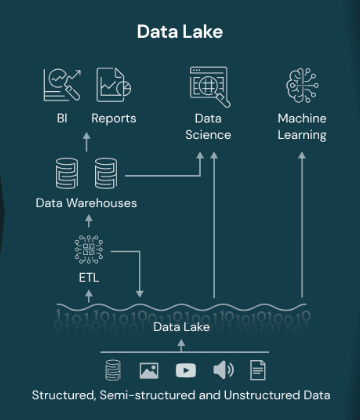
However, data lakes came with their own set of limitations. While they offered unprecedented flexibility, they sacrificed basic data management capabilities, particularly ACID (Atomicity, Consistency, Isolation, Durability) properties. This often meant organizations needed both solutions: a data lake for exploration and a data warehouse for structured analytics.
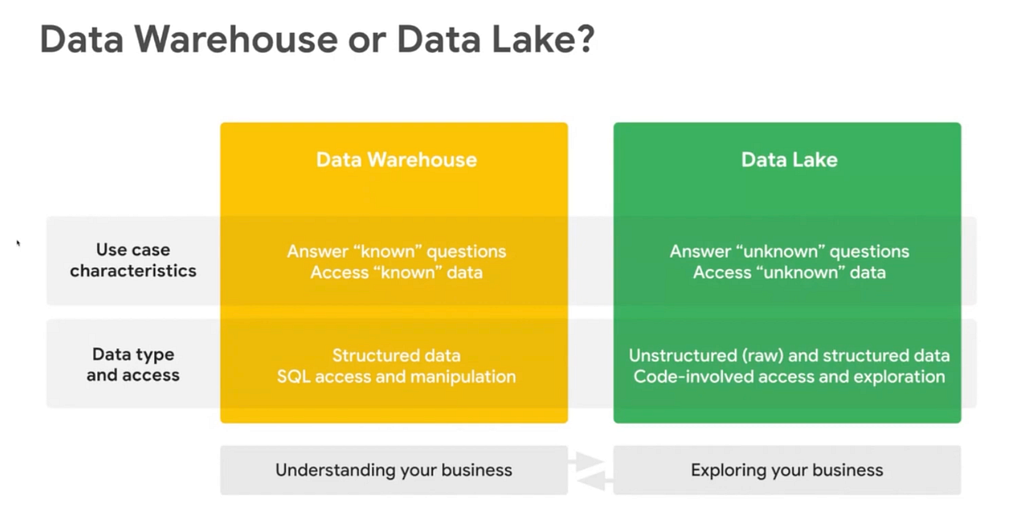
The two approaches served different purposes:
- Data Warehouses: Answered known questions about known data through SQL, focusing on understanding current business metrics
- Data Lakes: Explored unknown questions about unknown data through code, enabling business discovery and innovation
The Data Lakehouse: Best of Both Worlds
Enter the data lakehouse, introduced in the 2020s. This architectural pattern combines the best aspects of data lakes and data warehouses while eliminating their respective limitations. Databricks pioneered this approach, introducing it to the industry with several key innovations.
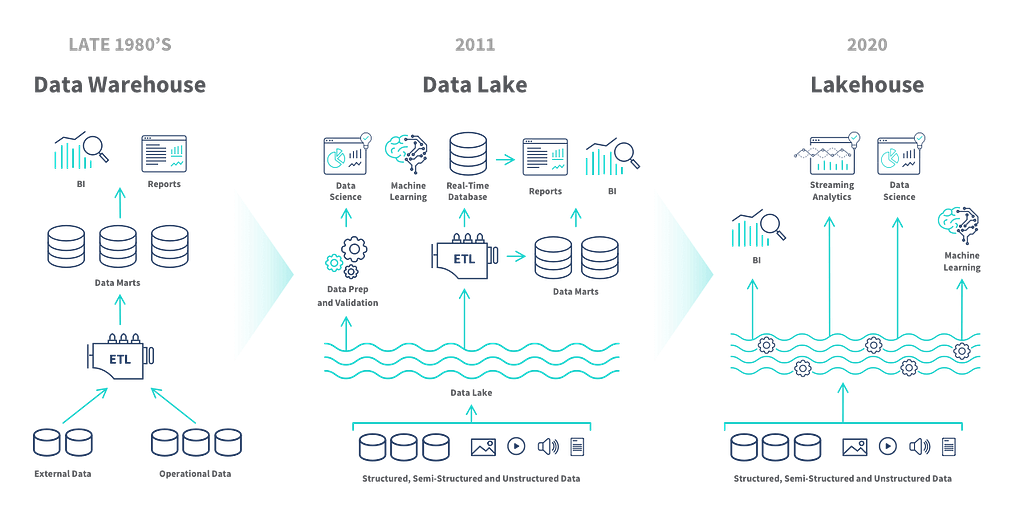
Unlike traditional data warehouses, the data lakehouse doesn’t store data in proprietary formats. Instead, it utilizes cloud storage with the open-source formats like Delta Lake and Iceberg, offering several advantages:
- Files stored in Parquet columnar format, optimized for analytics
- Transaction log enabling ACID capabilities
- Cost-effective cloud object storage
- Open-source format accessible beyond specific platforms
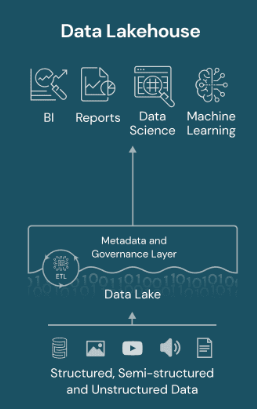
In summary, the data lakehouse architecture provides:
- The flexibility and scalability of data lakes
- The reliability and performance of data warehouses
- Support for diverse data types and analytical methods
- Cost-effective storage and processing
- Open formats that prevent vendor lock-in
Conclusion
The data lakehouse represents a significant evolution in data architecture, offering organizations a unified solution for their data storage and analytics needs. By combining the best features of data lakes and data warehouses, while eliminating their respective drawbacks, data lakehouses provide a robust foundation for modern data strategies. As organizations continue to generate and analyze increasing volumes of diverse data, the data lakehouse architecture offers a compelling path forward for scalable, flexible, and efficient data management.