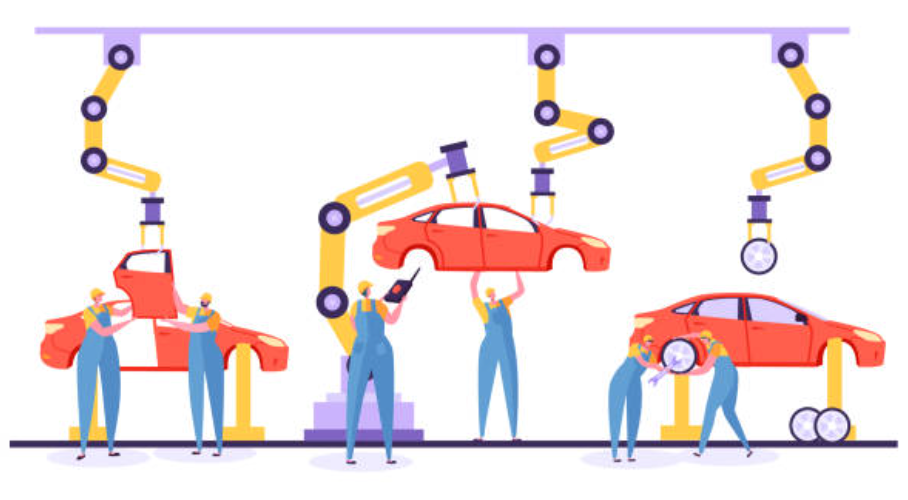
Imagine walking into a bustling car manufacturing plant. Workers are stationed at different points along a conveyor belt, each performing specific tasks as partially assembled vehicles move from station to station. Raw materials enter at one end, and finished cars emerge at the other. This is the essence of an assembly line — and it’s also the perfect metaphor for understanding Apache Spark’s approach to data processing.
The Traditional Factory vs. The Assembly Line
Before Henry Ford revolutionized manufacturing with assembly lines, cars were built by individual craftsmen who would complete entire vehicles from start to finish. This approach was slow, expensive, and couldn’t scale to meet demand. Similarly, traditional data processing systems often handle data in a sequential, single-threaded manner — one record at a time, one operation at a time.
Apache Spark changed the game by introducing the “assembly line” approach to big data processing. Instead of processing data records individually, Spark distributes the work across multiple “stations” (worker nodes) that can operate simultaneously on different portions of your data.
The Spark Assembly Line: Key Components
The Conveyor Belt: RDDs and DataFrames
In our assembly line metaphor, the conveyor belt represents Spark’s fundamental data structures — Resilient Distributed Datasets (RDDs) and DataFrames. Just as a conveyor belt carries car parts from station to station, these data structures carry your information through various processing stages.
The beauty of Spark’s “conveyor belt” is that it’s fault-tolerant. If one section breaks down (a worker node fails), the system can reconstruct the lost data using the lineage information — like having a blueprint that shows exactly how to rebuild any part that gets damaged.
The Workers: Executors
Each worker on the assembly line represents a Spark executor — a process running on a worker node that performs the actual data processing tasks. Just like factory workers who focus on one specific operation (installing engines, painting, or quality control), each Spark executor handles one specific task in your data processing chain at any given time.
The magic happens when you have multiple executors working in parallel. Picture an assembly line with ten workers, each installing engines on different cars simultaneously. Similarly, when Spark needs to filter a large dataset, ten executors can each filter different chunks of that data at the same time, completing the filtering step much faster than a single worker could.
The Supervisor: The Driver Program
The driver program is like the factory supervisor who oversees the entire assembly line. It breaks down the overall job into smaller tasks, assigns these tasks to different workers, and monitors progress. The driver maintains the “master plan” of what needs to be built and coordinates all the moving parts.
The Stations: Transformations and Actions
In a car assembly line, different stations perform different operations: welding, painting, installing components. In Spark, these stations are represented by transformations and actions.
Transformations are like the intermediate stations where parts are modified but the car isn’t complete yet. Examples include:
- Filter: Quality control stations that remove defective parts
- Join: Assembly stations that combine different parts
Actions are like the final inspection and shipping stations where the completed product is actually delivered:
- Collect: Gathering all finished cars for shipment
- Count: Taking inventory of completed vehicles
Optimizing Your Assembly Line
Just as factory supervisors optimize assembly lines for maximum efficiency, you can optimize your Spark jobs:
Right-size your workforce: Configure the appropriate number of executors for your job size. Too few workers and a job that could finish in minutes ends up taking hours; too many and you’re wasting them on coordination overhead.
Balance the workload: Ensure data is evenly distributed across partitions. Uneven partitions are like having some workers overwhelmed with too many cars to work on while others stand idle.
Minimize data movement: Just as factories keep all the cars for the same dealership together on one shipping dock instead of scattering them across different loading areas, you should partition your data by relevant IDs so when you need to process all the records for that ID, they’re already on the same node.
Cache frequently used data: If certain data will be used multiple times, cache it in memory — like keeping commonly used parts readily available at each station.
Conclusion
Apache Spark revolutionized big data processing by applying assembly line principles to distributed computing. Just as Henry Ford transformed manufacturing by breaking down car production into parallelizable tasks across multiple workers, Spark breaks down data processing jobs and distributes them across multiple nodes for faster, more reliable processing.
The next time you’re working with Spark, picture that bustling factory floor with coordinated workers and efficient workflows. Your data is moving through a sophisticated assembly line designed to transform raw information into valuable insights — ready to handle whatever scale your business demands.